









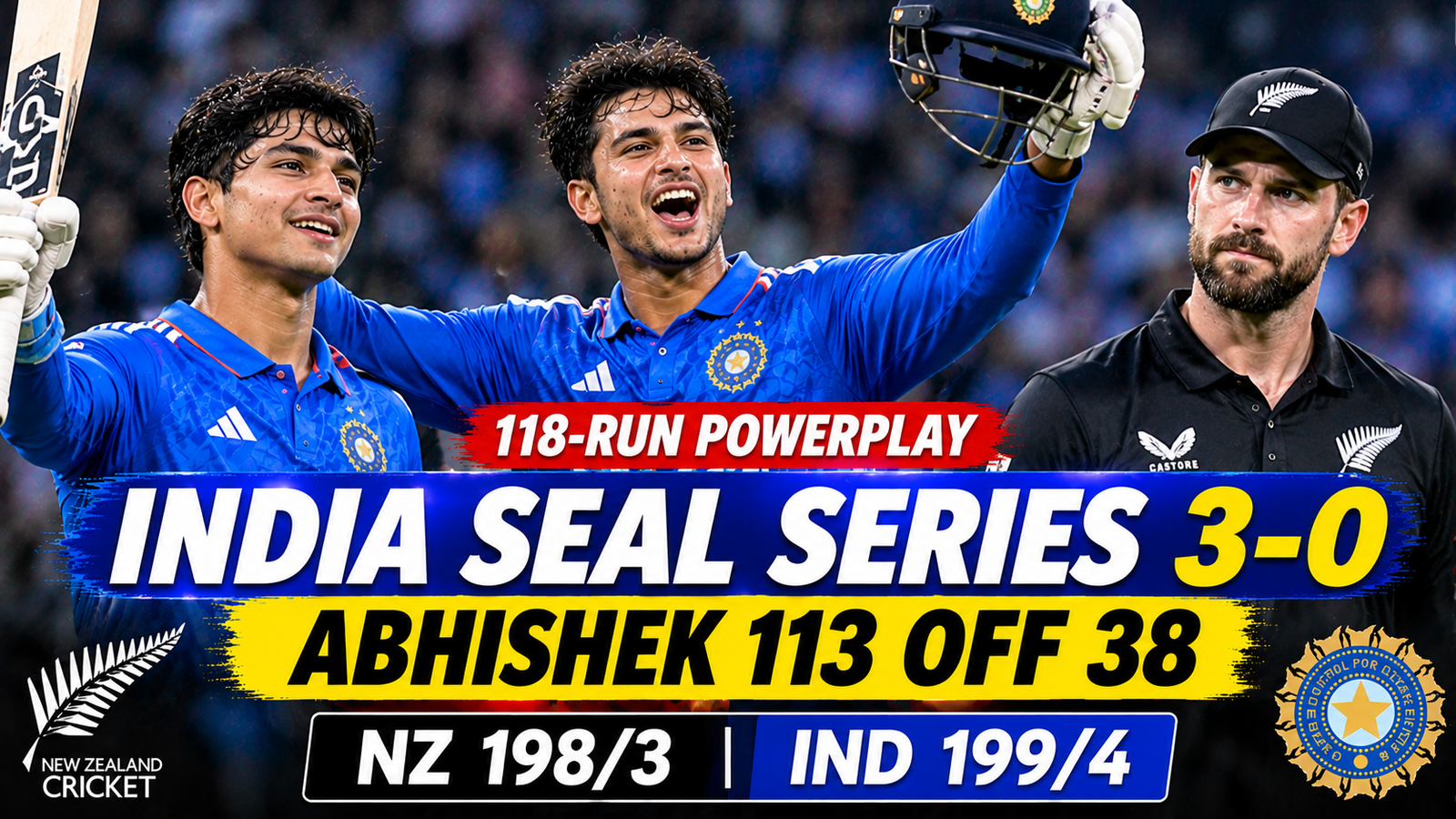
India produced a dominant performance in the 3rd T20 to beat New Zealand and take an unassailable 3-0 lead in the five-match series.
The victory came with two matches still to play. India controlled the contest with the bat after New Zealand had posted a competitive total, thanks largely to Daryl Mitchell’s unbeaten 89.
A record-breaking Powerplay then turned the match heavily in India’s favour.
Shreyas Iyer won the toss again and chose to field first. New Zealand lost Tim Seifert early, but Finn Allen and Daryl Mitchell quickly changed the momentum.
The pair attacked the Indian bowlers and gave the hosts a strong platform. Allen eventually fell in the 40s, but Mitchell continued to bat deep into the innings.
The New Zealand all-rounder remained unbeaten on 89 and received useful support from Bevon Jacobs. Their contributions helped New Zealand stay competitive despite losing wickets at regular intervals.
India were not at their most effective with the ball in the 3rd T20 against New Zealand. Bhuvneshwar Kumar again struggled to make a major impact, while the hosts found opportunities to score freely during the middle overs.
However, India improved significantly at the death.
Prince Yadav returned strongly and played an important role in restricting the scoring. Arshdeep Singh and Nitish Kumar Reddy also executed their yorkers well during the final overs.
As a result, New Zealand finished below the 200-run mark.
New Zealand needed a strong start with the ball to defend their total.
Instead, India completely took control from the opening over.
The visitors made a change at the top of the order, promoting Vaibhav Sooryavanshi to open alongside Abhishek Sharma. The move immediately paid off.
The two left-handers attacked from the beginning and put the New Zealand bowlers under immense pressure.
India scored 118 runs during the Powerplay. That became a record Powerplay score by a full-member nation in T20I cricket.
The opening partnership eventually reached 133 runs before New Zealand finally broke through.
Abhishek was the main aggressor. He found boundaries around the ground and maintained an exceptional scoring rate throughout his innings.
He brought up a remarkable century from only 35 balls before eventually departing.
Sooryavanshi missed out on a half-century, but his aggressive start gave India the platform they needed.
New Zealand’s bowling attack never recovered from the Powerplay assault.
The hosts conceded 118 runs during the first six overs and 178 within the opening 10. That left India needing only a short passage of controlled batting to finish the chase.
Kyle Jamieson and Mitchell Santner eventually picked up wickets as India lost some momentum towards the end.
Matthew Fisher also claimed his maiden T20I wicket when he dismissed Sooryavanshi. However, those breakthroughs arrived too late to change the outcome.
Santner’s decision not to bowl himself early also left New Zealand without one of their key options during the most expensive phase of the innings.
India eventually completed the chase with plenty of deliveries remaining in the 3rd T20 against New Zealand.
The result gave India a 3-0 lead with two matches still remaining.
New Zealand had produced a competitive batting effort, with Mitchell’s unbeaten 89 giving them hope of defending the total.
However, their bowling and fielding failed to match that effort. The 118-run Powerplay effectively settled the contest before the innings had fully developed.
India, meanwhile, combined aggressive batting with improved execution at the death to secure another convincing victory.
With the series already decided, New Zealand now face two final opportunities to avoid a clean sweep. India, on the other hand, will look to maintain their momentum and complete a dominant series.